
(algorithm)
Definition: (1) Any search algorithm that considers outgoing edges (children) of a vertex before any of the vertex's siblings, that is, outgoing edges of the vertex's predecessor in the search. Extremes are searched first. This is easily implemented with recursion. (2) An algorithm that marks all vertices in a directed graph in the order they are discovered and finished, partitioning the graph into a forest.
Also known as DFS.
Specialization (... is a kind of me.)
preorder traversal, in-order traversal, postorder traversal.
See also breadth-first search, best-first search, Schorr-Waite graph marking algorithm.
Note: Depth-first search doesn't specify if a vertex is considered before, during, or after its outgoing edges or children. Thus it can be preorder, in-order, or postorder traversal.
Author: PEB
Lecture notes from Design and Analysis of Algorithms on Breadth-first search and depth-first search. An animation (Java).
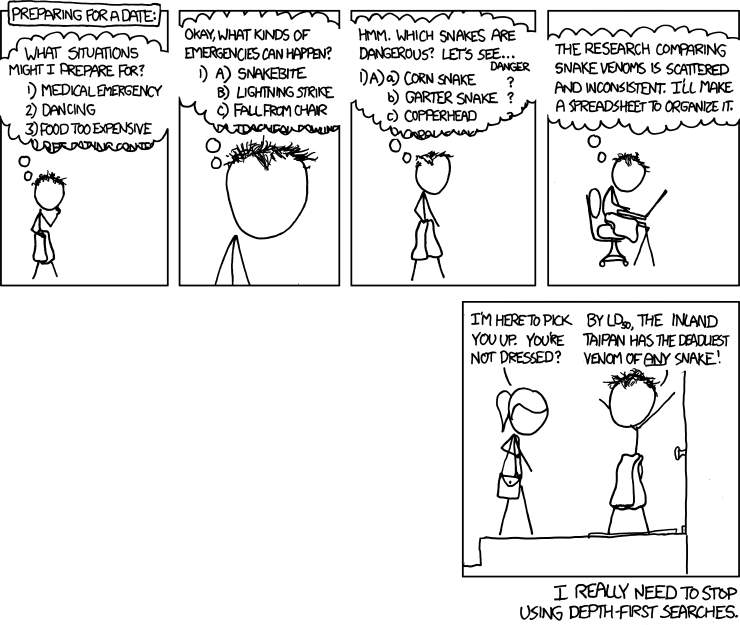
From xkcd by Creative Commons Attribution-NonCommercial 2.5 License.
An early mention of depth-first search:
C. Cordell Green and Bertram Raphael, The use of theorem-proving techniques in question-answering systems, Proc. 1968 23rd ACM national conference, pages 169-181, 1968.
Uses just "depth-first search" in the body (page 5), but contrasts depth-first with breadth-first search in a footnote.
An earlier description of what we would call depth-first search with pruning of infeasible solutions.
Solomon W. Golomb and Leonard D. Baumert, Backtrack Programming, Journal of ACM, 12(4):516-524, Oct 1965.
If you have suggestions, corrections, or comments, please get in touch with Paul Black.
Entry modified 22 April 2015.
HTML page formatted Mon May 18 09:42:24 2015.
Cite this as:
Paul E. Black, "depth-first search", in
Dictionary of Algorithms and Data Structures [online], Vreda Pieterse and Paul E. Black, eds. 22 April 2015. (accessed TODAY)
Available from: http://www.nist.gov/dads/HTML/depthfirst.html